
Antibody-drug Conjugates

The Hidden Variable in Your ADC Experiment: Why Isotype Controls Must Match the Whole Molecule

Antibody-drug conjugates (ADCs) have made remarkable progress in recent years, combining the specificity of targeted antibodies with the potent cell-killing ability of cytotoxic payloads. As these molecules grow more structurally complex, the design of appropriate experimental controls must keep pace. A persistent challenge in ADC development is the continued use of standard unconjugated isotype controls in functional assays, including cytotoxicity, binding, and internalization, a practice that can produce misleading results when non-specific payload activity is misinterpreted as target-specific engagement. In this blog, we discuss the limitations of standard isotype controls in ADC experiments, outline the critical components of a properly [...]

By |2026-04-16T12:17:10-07:00April 16th, 2026|Antibody-drug Conjugates, Bioconjugation, Blog|0 Comments

The ABCs of ADCs: An Introduction to Antibody-drug Conjugates

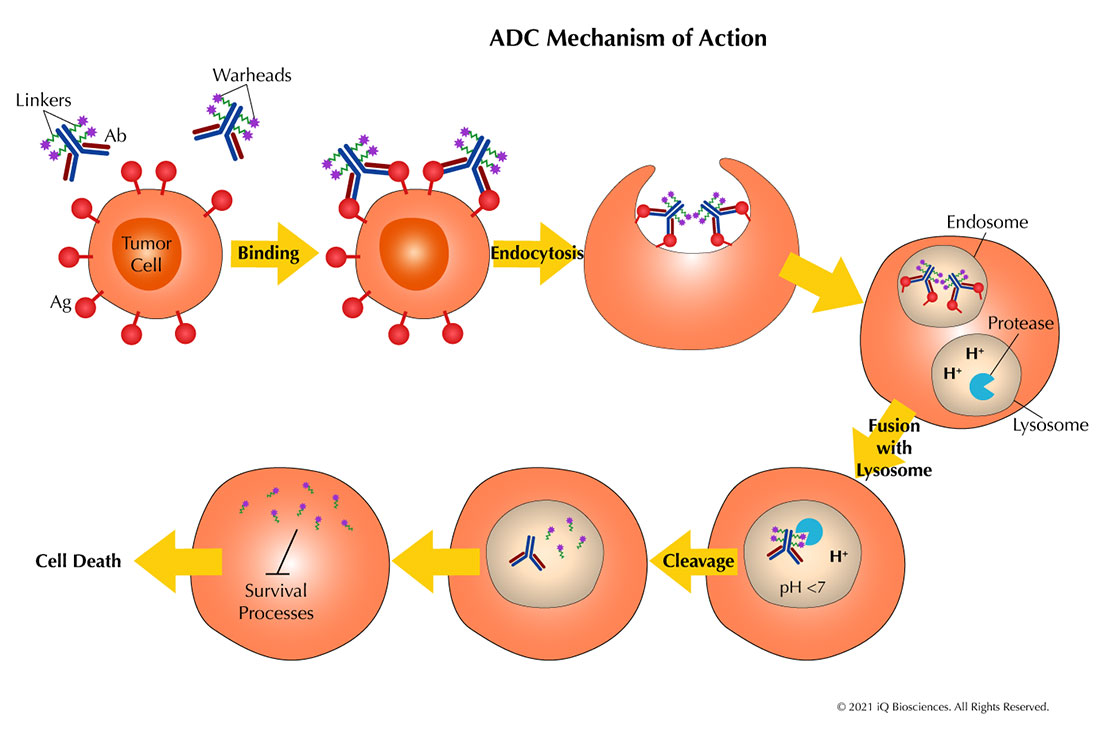
The terms “warhead” and “payload” typically invoke impressions of weapons and destruction. However, in a more constructive and positive light, these terms are now also commonly associated with antibody-drug conjugates (ADCs), a class of biologics used to treat cancer. These warheads and cytotoxic payloads are an integral part of ADCs that drive tumor cell death. Coupled to antibodies, ADCs combine the advantage of both modalities to be a potent class of anti-cancer molecules.In this blog, we will discuss the components that make up ADCs, what they are used for, and the future for this class of biologics. What [...]

By |2021-12-19T13:22:40-08:00June 18th, 2021|Antibody-drug Conjugates, Bioservices, Blog|0 Comments
Go to Top