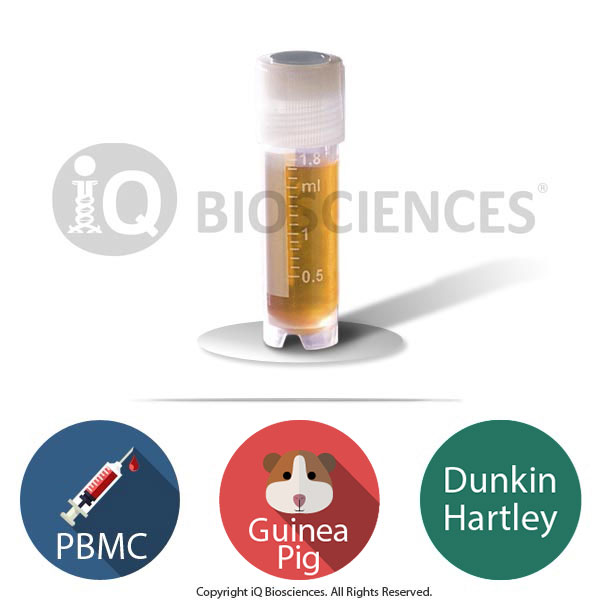
- High-quality Dunkin Hartley guinea pig PBMCs sourced responsibly from a vetted third party facility
- High viability (> 80%) after thawing
- Used for a wide variety of immune functional assays or immunophenotyping
- All orders come with an iQ Certificate of Analysis
- Normally ships out same business day
Dunkin Hartley Guinea Pig Peripheral Blood Mononuclear Cells (PBMCs)
$530.00
 Powered by Bioz
Description
About the Dunkin Hartley Guinea Pig
The Dunkin Hartley guinea pig is a commonly used outbred strain of guinea pig that is employed in a variety of preclinical research in immunology, virology, cardiology, metabolism, and arthritis. Response to tuberculosis is often studied in guinea pigs and more recently, immune cells isolated from guinea pigs have been frequently used to study B cell development and activation, T cell population characterization, and T cell responses.
Application Summary for Guinea Pig PBMCs
Guinea pig PBMCs can be used for a wide variety of immunology-based applications. In vitro immunoassays, such as proliferation, cytotoxicity, and cytokine release in response to stimulus, including antigens specifically from tuberculosis, are commonly performed with guinea pig PBMCs. Similarly, characterization of cell surface marker or mRNA transcriptional changes in PBMCs in response to stimulus can also be performed using guinea pig PBMCs.
Gamma delta (g/d) T cells, which is of particular interest to researchers currently, have been characterized in guinea pigs and may be a source of cells to study g/d T cell biology.
Isolation of PBMCs
Peripheral blood is obtained from responsible facilities that have many years of experience collecting samples. Since the facilities are local, the blood is quickly transported to iQ Bioscience’s laboratory for processing.
Once at our lab, PBMCs are isolated by performing density centrifugation with Ficoll, a high molecular weight sucrose solution, to remove red blood cells under sterile conditions. Depending on the species (human or non-human) of blood, either 1.077 or 1.084 g/ml Ficoll is used, resulting in a perfect layer of mononuclear cells that are separated from plasma, platelets, granulocytes, and erythrocytes. Additional quality control steps are taken to isolate and prepare PBMCs that ensure the highest viability for cryopreservation and downstream experimental applications.
Cryopreservation and Storage
Our guinea pig PBMCs are cryopreserved carefully using iQ Biosciences’ cryopreservation protocol that ensures high viability (> 80%) after thawing.
Cells should be stored at < -120°C once they are received, such as within a liquid nitrogen tank (vapor phase).
Additional information
| Available Size(s) | |
|---|---|
| Format | |
| Cell Type | |
| Tissue Type | |
| Species | |
| Viability | > 80% |

Tailored Experiments
Your research is important to us. Our scientists will work through each step of the process with you, including assay design, data analysis, and recommendations for future studies.

Streamlined Process
Simplify your workflow. Bypass the middle-man: at iQ Biosciences, you'll get immediate access to our biospecimen inventory, saving you both valuable time and money.

Expertise
We're experts- so you don't have to be. Augmenting years of experience in immunology and working with immune assays, our scientists stay current with the latest publications and technology.

Exceptional Service
We're here to help. We know the challenges you're facing: whether it be through expedited service or our complimentary consulting services, our team is dedicated to helping you reach your goals.
For US customers, we ship via FedEx Overnight Shipping. Shipping charges will vary per shipping address (based on ZIP code) and are estimated to be $140.
For international (non-US) customers, we work closely with you and our couriers to ensure all necessary documentation is in place for international shipments to significantly reduce the chance of delays at Customs. For the export of non-human primate samples, this includes preparing CITES permits, as well as any other documentation as required by country. Please submit an inquiry to orders@iqbiosciences.com for your estimated time of delivery and shipping charges.
Austria 
Hölzel Diagnostika Handels GmbH
Tel: +49 221 126 02 66
Email: info@hoelzel.de
Web: https://www.hoelzel-biotech.com/
Canada 
Cedarlane
Tel: +1 (289) 288-0001
Toll Free (North America): +1 (800) 268-5058
Fax: +1 (289) 288-0020
Email: sales@cedarlanelabs.com
Web: https://www.cedarlanelabs.com
China 
BIOHUB INTERNATIONAL TRADE CO., LTD.
上海起发实验试剂有限公司
Address: Chuansha Rd #6619, Pudong, Shanghai, Zipcode: 201200 P.R.China
Tel: 0086-021-50724187
Phone: +86-15921799099
Fax: 0086-021-50724961
Email: sale3@78bio.com
Web: www.qfbio.com
European Union 
Caltag Medsystems Ltd.
Email: office@caltagmedsystems.co.uk
Web: https://www.caltagmedsystems.co.uk
tebu-bio
Web: https://www.tebu-bio.com
Or Find a local contact
Germany 
Hölzel Diagnostika Handels GmbH
Tel: +49 221 126 02 66
Email: info@hoelzel.de
Web: https://www.hoelzel-biotech.com/
Zageno
Web: https://zageno.com/
Ireland 
2B Scientific Ltd
Tel: +44(0) 1869 238033
Fax: +44(0) 1869 238034
Email: sales@2BScientific.com
Web: https://www.2bscientific.com
India 
Cell & Gene BioSolutions Pvt. Ltd.
#478 C, SLV Complex, Raghavendra Swamy Mutt Road
Opp. Turahalli Water Tank, Turahalli, Subramanyapura Post
Uttarahalli Hobli, Bengaluru-560061, Karnataka, India
Phone: +91 97317 14670
Phone: +91 98809 25033
Email: info@cgbios.com
Web: www.cgbios.com
Japan 
Cosmo Bio Co., Ltd.
Tel: +81 (03) 5632 9610
Fax: +81 (03) 5632 9619
Email: nsmail@cosmobio.co.jp
Web: https://www.cosmobio.co.jp
Qatar 
Sedeer Medical Services and Trading LLC
Tel: +974 4434 9191
Email: info@sedeer.com
Web: https://sedeer.com/
Singapore 
Omnicell Pte Ltd
Tel: +65 6747 0201
Email: enquiry@omnicell.com.sg
Web: https://omnicell.com.sg/</a
South Korea 
BioClone
Tel: +82-2-2690-0058
Email: bioclone@bioclone.co.kr
Web: http://www.bioclone.co.kr
Switzerland 
Hölzel Diagnostika Handels GmbH
Tel: +49 221 126 02 66
Email: info@hoelzel.de
Web: https://www.hoelzel-biotech.com/
Taiwan 
Hycell International Co. Ltd.
Tel: +886-2-2877-1122
Fax: +886-2-2876-1520
Web: http://www.hycell.com.tw
United Kingdom 
2B Scientific Ltd
Tel: +44(0) 1869 238033
Fax: +44(0) 1869 238034
Email: sales@2BScientific.com
Web: https://www.2bscientific.com
Caltag Medsystems Ltd.
Tel: +44 (0)1280 827460
Fax: +44 (0)1280 827466
Email: office@caltagmedsystems.co.uk
Web: https://www.caltagmedsystems.co.uk
tebu-bio
Tel: +44 (0)1733 421880
Fax: +44 (0)1733 421882
Email: uk@tebu-bio.com
Web: https://www.tebu-bio.com
Zageno
Web: https://zageno.com/
United States 
Fisher Scientific
Tel: 1-800-766-7000
Web: https://www.fishersci.com
Quartzy
Web: https://www.quartzy.com
VWR International
Tel: 1-800-932-5000
Web: https://www.vwr.com
Zageno
Web: https://zageno.com/