- Human Treg functional kits with CD4+CD25+FOXP3+ Regulatory T cells and CD8 T cell or PBMC responders
- CD8 T cells and PBMCs can be CFSE-labeled for downstream functional readout
- Treg cells are validated for regulatory function
- Used to test molecules for modulation of Treg function
- Carefully cryopreserved to ensure high viability (> 90%) upon thawing
- All orders come with an iQ Certificate of Analysis
Treg Suppression Assay Kit
$1,590.00 – $8,670.00
 Powered by Bioz
Description
About iQ Biosciences’ Human Treg Suppression Assay Kit
Regulatory T cells (Tregs) are currently being targeted as a modality to reshape the disease environment to modulate T cell function. In cases of autoimmunity, therapeutics are being developed to enhance Treg function, while in cancer, molecules are developed to abrogate Treg function. To develop these molecules, Treg suppression assays are commonly used to assess whether a potential therapeutic can inhibit or promote Treg function. In these assays, Tregs are co-cultured with responder cells, such as CD8 T cells or PBMCs, and functional readouts of the responder cells are performed at the end of the culture period. Proliferation and cytokine production are often used to assess function.
iQ Biosciences has made it simple to perform these assays with our Human Treg Suppression Assay kit. The kit includes human CD4+CD25+FOXP3+ Tregs validated for suppressive function and your choice of CD8 T cells or PBMCs. The kit contains plenty of cells to evaluate multiple Treg:responder cell ratios to demonstrate functional consistency and provide insights into the potency of Treg modulation if therapeutic molecules are included in the co-cultures.
The responder cells can be labeled with CFSE (or a proliferation dye of your choosing) so downstream interrogation of proliferation is made simple. After the culture period, the cells can be harvested and analyzed with a flow cytometer to examine dilution of CFSE in responder cells, which reflects proliferative function. Molecules that promote Treg function will demonstrate less proliferation while those that inhibit Treg function will demonstrate more proliferation relative to untreated control.
To test the effect of your molecule with the Human Treg Suppression Assay Kit, simply thaw the cells and co-culture the Tregs and responders at the desired ratios in the presence of the molecule. After the culture period, CFSE dilution can be analyzed on a flow cytometer.
Tregs and Responder Cells in the Treg Suppression Assay Kit
Tregs in the Treg Suppression Assay Kit are analyzed for the expression of CD4, CD25, FOXP3, and CD127. Characterization of Treg cells, as defined by CD4, CD25, FOXP3, and CD127 expression, was shown to be greater than 85% pure.
The Treg Suppression Assay Kit also comes with your choice of either pure CD8 T cells or PBMCs as responder cells. PBMCs are isolated from blood obtained from a local world-renowned collection facility using a sterile isolation method that permits T cells to retain function. In contrast, CD8 T cells are obtained from isolated PBMCs using magnetic cell sorting. Typical purities of the isolated CD8 cells are greater than 90%.
The Tregs included in the kit have been validated to have suppressive characteristics (Figure 1 and 2) so researchers can have confidence using these cells. Investigators simply need to follow the included protocol and add the therapeutic molecule they are assessing.
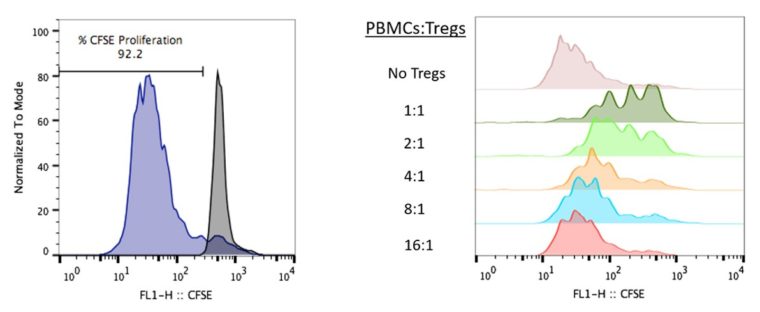
Figure 1. Human Tregs suppress proliferation of CD8 T cells. PBMCs were labeled with CFSE and co-cultured at different ratios of Tregs in the presence or absence of stimulation. After 4 days of co-culture, cells were stained with CD8 antibody and flow cytometric analysis was performed. (Left) Histograms of CFSE staining for unstimulated (gray) and stimulated (purple) CD8 T cells. Marker for proliferation is set based on unstimulated cells. (Right) Histograms of CFSE staining for CD8 T cells co-cultured with different ratios of Tregs.
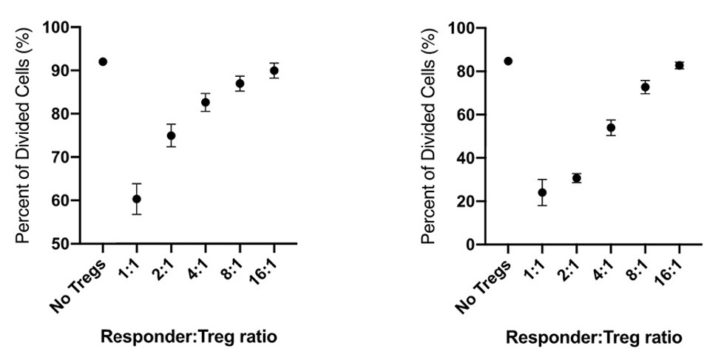
Figure 2. Human Tregs suppress proliferation of CD8 T cells. PBMCs were labeled with CFSE and co-cultured at different ratios of Tregs in the presence or absence of stimulation. After 4 days of co-culture, cells were stained with CD8 antibody and flow cytometric analysis was performed. For analysis, dilution of CFSE was assessed on CD8 positive gate. Marker for CFSE dilution was set using unstimulated cells. (Left, Right) Graphs show the percent of divided CD8 cells based on CFSE dilution analysis from 2 different donors. At lower responder:Treg ratio, more suppression is observed.
Cryopreservation and Storage
Human Tregs, PBMCs, and CD8 T cells were cryopreserved carefully using iQ Biosciences’ cryopreservation protocol that ensures high viability (> 90%) after thawing.
Cells should be stored at < -120°C once they are received, such as within a liquid nitrogen tank (vapor phase).
Quality Control Process
We implement random sampling per lot to test for viability and cell counts to ensure they meet specifications, which are recorded on the Certificate of Analysis that is included with each shipment. Cell counts are obtained using a manual hemocytometer and then cross-referenced with an automated cell counter. Each lot is also characterized for unique cell populations by immunophenotyping, in which the results are also recorded on the Certificate of Analysis.
Additional information
| Available Formats | Kit w/ PBMC Responders, Kit w/ PBMC Responders – 5 Pack, Kit w/ Cytotoxic CD8 T Cell Responders, Kit w/ Cytotoxic CD8 T Cell Responders – 5 Pack, Kit w/ CFSE-labeled PBMC Responders, Kit w/ CFSE-labeled PBMC Responders – 5 Pack, Kit w/ CFSE-labeled Cytotoxic CD8 T Cell Responders, Kit w/ CFSE-labeled Cytotoxic CD8 T Cell Responders – 5 Pack |
|---|---|
| Format | |
| Species |
We are Committed to Ethical Practices
iQ Biosciences’ human primary cell products are lawfully obtained in accordance with Local, State, and Federal U.S. requirements, and the collection of cells complies with ethical requirements. Our cells are obtained from normal or disease patient volunteers participating in a donor program that is approved by an Institutional Review Board (IRB) or Human Subject Committee. A signed and witnessed consent form is obtained from donor volunteers prior to starting the collection protocol. Strict controls on personal identifiers of volunteers are in place in order to protect their privacy.

Tailored Experiments
Your research is important to us. Our scientists will work through each step of the process with you, including assay design, data analysis, and recommendations for future studies.

Streamlined Process
Simplify your workflow. Bypass the middle-man: at iQ Biosciences, you'll get immediate access to our biospecimen inventory, saving you both valuable time and money.

Expertise
We're experts- so you don't have to be. Augmenting years of experience in immunology and working with immune assays, our scientists stay current with the latest publications and technology.

Exceptional Service
We're here to help. We know the challenges you're facing: whether it be through expedited service or our complimentary consulting services, our team is dedicated to helping you reach your goals.
For US customers, we ship via FedEx Overnight Shipping. Shipping charges will vary per shipping address (based on ZIP code) and are estimated to be $140.
For international (non-US) customers, we work closely with you and our couriers to ensure all necessary documentation is in place for international shipments to significantly reduce the chance of delays at Customs. For the export of non-human primate samples, this includes preparing CITES permits, as well as any other documentation as required by country. Please submit an inquiry to orders@iqbiosciences.com for your estimated time of delivery and shipping charges.
Austria 
Hölzel Diagnostika Handels GmbH
Tel: +49 221 126 02 66
Email: info@hoelzel.de
Web: https://www.hoelzel-biotech.com/
Canada 
Cedarlane
Tel: +1 (289) 288-0001
Toll Free (North America): +1 (800) 268-5058
Fax: +1 (289) 288-0020
Email: sales@cedarlanelabs.com
Web: https://www.cedarlanelabs.com
China 
BIOHUB INTERNATIONAL TRADE CO., LTD.
上海起发实验试剂有限公司
Address: Chuansha Rd #6619, Pudong, Shanghai, Zipcode: 201200 P.R.China
Tel: 0086-021-50724187
Phone: +86-15921799099
Fax: 0086-021-50724961
Email: sale3@78bio.com
Web: www.qfbio.com
European Union 
Caltag Medsystems Ltd.
Email: office@caltagmedsystems.co.uk
Web: https://www.caltagmedsystems.co.uk
tebu-bio
Web: https://www.tebu-bio.com
Or Find a local contact
Germany 
Hölzel Diagnostika Handels GmbH
Tel: +49 221 126 02 66
Email: info@hoelzel.de
Web: https://www.hoelzel-biotech.com/
Zageno
Web: https://zageno.com/
Ireland 
2B Scientific Ltd
Tel: +44(0) 1869 238033
Fax: +44(0) 1869 238034
Email: sales@2BScientific.com
Web: https://www.2bscientific.com
India 
Cell & Gene BioSolutions Pvt. Ltd.
#478 C, SLV Complex, Raghavendra Swamy Mutt Road
Opp. Turahalli Water Tank, Turahalli, Subramanyapura Post
Uttarahalli Hobli, Bengaluru-560061, Karnataka, India
Phone: +91 97317 14670
Phone: +91 98809 25033
Email: info@cgbios.com
Web: www.cgbios.com
Japan 
Cosmo Bio Co., Ltd.
Tel: +81 (03) 5632 9610
Fax: +81 (03) 5632 9619
Email: nsmail@cosmobio.co.jp
Web: https://www.cosmobio.co.jp
Qatar 
Sedeer Medical Services and Trading LLC
Tel: +974 4434 9191
Email: info@sedeer.com
Web: https://sedeer.com/
Singapore 
Omnicell Pte Ltd
Tel: +65 6747 0201
Email: enquiry@omnicell.com.sg
Web: https://omnicell.com.sg/</a
South Korea 
BioClone
Tel: +82-2-2690-0058
Email: bioclone@bioclone.co.kr
Web: http://www.bioclone.co.kr
Switzerland 
Hölzel Diagnostika Handels GmbH
Tel: +49 221 126 02 66
Email: info@hoelzel.de
Web: https://www.hoelzel-biotech.com/
Taiwan 
Hycell International Co. Ltd.
Tel: +886-2-2877-1122
Fax: +886-2-2876-1520
Web: http://www.hycell.com.tw
United Kingdom 
2B Scientific Ltd
Tel: +44(0) 1869 238033
Fax: +44(0) 1869 238034
Email: sales@2BScientific.com
Web: https://www.2bscientific.com
Caltag Medsystems Ltd.
Tel: +44 (0)1280 827460
Fax: +44 (0)1280 827466
Email: office@caltagmedsystems.co.uk
Web: https://www.caltagmedsystems.co.uk
tebu-bio
Tel: +44 (0)1733 421880
Fax: +44 (0)1733 421882
Email: uk@tebu-bio.com
Web: https://www.tebu-bio.com
Zageno
Web: https://zageno.com/
United States 
Fisher Scientific
Tel: 1-800-766-7000
Web: https://www.fishersci.com
Quartzy
Web: https://www.quartzy.com
VWR International
Tel: 1-800-932-5000
Web: https://www.vwr.com
Zageno
Web: https://zageno.com/